Institute కి రండి | Demo వినండి | Decide అవ్వండి. ( Online Class Available )

Institute కి రండి | Demo వినండి | Decide అవ్వండి. ( online class )

Digital Marketing AI Tools

Digital Marketing AI Tools - Digital Brolly
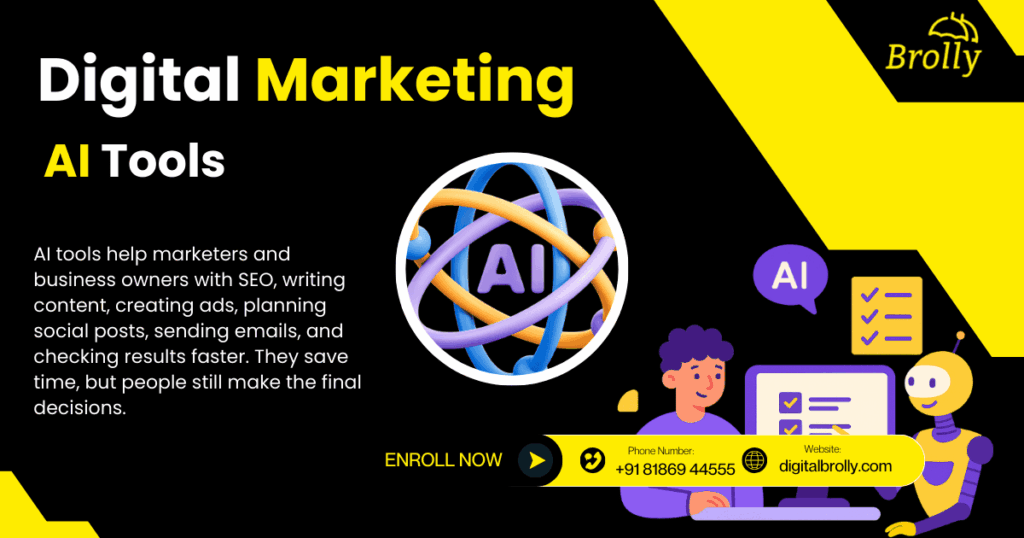
  • Digital marketing AI tools are smart software platforms that use artificial intelligence to help marketers plan, execute, and improve their online marketing activities. 
  • These tools are designed to reduce manual work, analyze large amounts of data quickly, and support better marketing decisions.
  • In simple terms, digital marketing AI tools act like intelligent assistants. 
  • They help marketers create content, improve website rankings, manage ads, handle social media, run email campaigns, and track performance all with more speed and accuracy. 
  • Instead of guessing what might work, marketers can rely on data-backed insights provided by AI.
  • For students, job seekers, marketers, and business owners, especially in fast growing digital markets like Hyderabad, learning digital marketing AI tools is becoming essential. 
  • Companies now expect professionals to understand both marketing fundamentals and AI-driven tools.

What Digital Marketing AI Tools Are Used For

Digital marketing AI tools support multiple areas of online marketing, including

  • Content creation – Helping write blogs, ad copies, emails, and social media posts
  • SEO optimization – Finding keywords, improving content quality, and analyzing search trends
  • Advertising – Optimizing ad budgets, targeting the right audience, and improving conversions
  • Social media marketing – Scheduling posts, generating captions, and tracking engagement
  • Email marketing –  Personalizing emails and automating follow-ups
  • Analytics and reporting – Turning complex data into simple performance insights

Why Digital Marketing AI Tools Are Important

These tools help marketers work smarter, not harder. Instead of spending hours on repetitive tasks, AI tools automate routine work and highlight what really matters.

Key benefits include

  • Faster and data-driven decision-making
  • Reduced manual effort and time savings
  • Better campaign performance and accuracy
  • Improved understanding of customer behavior
  • Higher productivity for individuals and teams

How AI Is Transforming Digital Marketing

  • AI is changing digital marketing from manual and experience-based work into a precise, data-driven process. 
  • Earlier, marketers had to analyze reports, test multiple strategies, and wait weeks to understand what worked. 
  • Today, AI tools provide insights almost instantly.

AI-powered digital marketing tools help by

  • Predicting user behavior, such as what users are likely to search, click, or buy next

  • Personalizing content at scale, so different users see content that matches their interests

  • Automatically optimizing ads, including targeting, bidding, and creatives for better conversions

  • Identifying SEO opportunities faster, such as content gaps, keyword trends, and ranking improvements
  • This transformation directly impacts career growth and business success. 
  • In competitive digital markets like Hyderabad, companies and agencies expect professionals to understand AI-driven marketing. 
  • Marketers who use AI tools can deliver better results, work more efficiently, and stay ahead in a fast-changing digital landscape.

Why Digital Marketing AI Tools Matter in 2025

  • Digital marketing in 2026 is driven by speed, data, and measurable results.
  • Businesses no longer depend only on manual strategies or basic tools.
  • Instead, they look for professionals who can use AI to analyze data, automate processes, and improve marketing performance. 
  • This shift makes digital marketing AI tools an essential skill for anyone aiming to grow in this field.

Rising Demand for AI-Powered Marketers

  • Companies today prefer marketers who can work with AI tools, not against them. 
  • As marketing platforms become more advanced, job roles are evolving. 
  • Many job descriptions now clearly mention skills such as AI-based SEO, marketing automation, performance optimization, and data interpretation.
  • For students and job seekers, especially in digital hubs like Hyderabad, learning digital marketing AI tools significantly increases employability.
  • Employers value candidates who can handle modern tools, understand data insights, and deliver faster results. 
  • Having AI skills helps candidates stand out in interviews and adapt quickly to real-world marketing environments.

Benefits of Using AI Tools in Marketing

AEO-Friendly Key Benefits

  • Faster campaign execution with automated workflows
  • Better audience targeting based on user behavior and data
  • Improved ROI on ads through smart optimization
  • Accurate and real-time performance insights
  • Reduced manual workload and repetitive tasks

Types of Digital Marketing AI Tools

Types of Digital Marketing AI Tools

AI Tools for WordPress Website Management

AI-powered WordPress tools help users build, manage, optimize, and scale websites without heavy technical knowledge. These tools support SEO, speed, security, and design.

Popular AI & Smart WordPress Tools
  • WordPress – Website creation and content publishing
  • Rank Math – AI-powered on-page SEO optimization
  • Yoast SEO – Content readability and SEO guidance
  • Elementor – Drag-and-drop website design
  • WP Rocket – Website speed and performance optimization
What These Tools Are Used For
  • Creating and managing WordPress websites
  • Publishing SEO-optimized blog content
  • Improving website speed and performance
  • Optimizing pages for search engines
  • Enhancing user experience and design
AI Tools for WordPress Website Management

Tool Name

Primary Use

What It Helps With

WordPress

Website CMS

Website creation and content publishing

Rank Math

SEO optimization

AI-based on-page SEO

Yoast SEO

SEO guidance

Readability and SEO checks

Elementor

Website design

Drag-and-drop page building

WP Rocket

Speed optimization

Caching and performance boost

AI Tools for Content Creation

  • AI content creation tools help marketers write faster, better, and more SEO-friendly content. 
  • These tools understand prompts, keywords, tone, and audience intent to generate usable content drafts.
Popular AI Content Creation Tools
  • ChatGPT – Blog writing, ad copy, captions, email drafts
  • Jasper – Marketing-focused content and ad copies
  • Copy.ai – Short-form marketing content
  • Writesonic – SEO blogs and landing pages
What These Tools Are Used For
  • Writing SEO blogs and articles
  • Creating Google Ads and social media ad copies
  • Generating landing page content
  • Writing email content and subject lines
  • Creating social media captions
AI Tools for Content Creation

Tool Name

Primary Use

What It Helps With

ChatGPT

AI content writing

Blogs, ad copy, captions, email drafts

Jasper

Marketing content

Sales copy, ads, landing page text

Copy.ai

Short-form content

Headlines, captions, product descriptions

Writesonic

SEO-focused writing

SEO blogs, landing pages

AI Tools for SEO and Keyword Research

AI SEO tools help marketers understand search behavior, ranking factors, and content opportunities using real-time search data.

Popular AI SEO & Keyword Research Tools
  • Semrush – Keyword research, competitor analysis
  • Ahrefs – Backlinks, keyword difficulty, SERP analysis
  • Surfer SEO – On-page SEO optimization
  • Ubersuggest – Beginner-friendly SEO insights

What These Tools Help With

  • Keyword clustering and intent analysis
  • Content optimization recommendations
  • SERP pattern analysis
  • Competitor research
  • Technical SEO insights

AI Tools for SEO and Keyword Research

Tool Name

Primary Use

What It Helps With

Semrush

Advanced SEO

Keyword research, competitor analysis

Ahrefs

SEO analytics

Backlinks, keyword difficulty, SERP analysis

Surfer SEO

On-page SEO

Content optimization suggestions

Ubersuggest

Beginner SEO

Keyword ideas, SEO insights

AI Tools for Social Media Marketing

AI social media tools automate posting, improve engagement, and provide performance insights across platforms.

Popular AI Social Media Tools
    • Hootsuite – Scheduling and analytics
    • Buffer – Post planning and performance tracking
    • SocialBee – Content recycling and scheduling
What These Tools Are Used For
  • Scheduling posts automatically
  • Generating captions and hashtags
  • Finding best posting times
  • Tracking engagement and growth
AI Tools for Social Media Marketing

Tool Name

Primary Use

What It Helps With

Hootsuite

Social media management

Scheduling, analytics

Buffer

Post planning

Scheduling, performance tracking

SocialBee

Automation

Content recycling, scheduling

Predis.ai

AI content

Captions, creatives, hashtags

AI Tools for Paid Ads and Performance Marketing

AI tools are heavily used in paid advertising to improve ROI and reduce wasted ad spend.

Popular AI Tools for Ads & Performance
  • Google Ads (AI Smart Bidding)
  • Meta Ads (AI targeting & creatives)
  • Adzooma – Campaign optimization
  • WordStream – AI ad recommendations
What These Tools Help With
  • Predicting high-performing creatives
  • Budget and bid optimization
  • Improving conversion rates
  • Reducing ad spend waste
AI Tools for Paid Ads and Performance Marketing

Tool Name

Primary Use

What It Helps With

Google Ads

Paid advertising

AI smart bidding, ad optimization

Meta Ads

Social ads

AI targeting, creative optimization

Adzooma

PPC automation

Campaign optimization

WordStream

PPC insights

AI-based ad recommendations

AI Tools for Email Marketing and Automation

AI email tools personalize communication and automate follow-ups based on user behavior.

Popular AI Email Marketing Tools
  • Mailchimp – AI-driven campaigns
  • HubSpot – Email + CRM automation
  • ActiveCampaign – Behavioral email workflows
  • Brevo – Personalization and automation
Common Use Cases
  • Lead nurturing campaigns
  • Automated follow-ups
  • Customer retention emails
  • Promotional newsletters
AI Tools for Email Marketing and Automation

Tool Name

Primary Use

What It Helps With

Mailchimp

Email campaigns

AI-driven email marketing

HubSpot

CRM + email

Automation and lead nurturing

ActiveCampaign

Email workflows

Behavioral automation

Brevo

Personalization

Automated email campaigns

AI Tools for Analytics and Reporting

AI analytics tools convert complex marketing data into simple dashboards and actionable insights, making performance tracking easy even for beginners.

Popular AI Analytics & Reporting Tools
  • Google Analytics (GA4 AI insights)
  • Looker Studio – Visual dashboards
  • Plerdy – UX and behavior analysis
  • Tableau – Advanced analytics
What These Tools Help With
  • Campaign performance tracking
  • Automated reporting
  • Trend identification
  • Actionable recommendations
AI Tools for Analytics and Reporting

Tool Name

Primary Use

What It Helps With

Google Analytics (GA4)

Website analytics

Traffic analysis, user behavior, AI insights

Looker Studio

Data visualization

Visual dashboards and reports

Plerdy

UX analytics

Heatmaps, behavior tracking

Tableau

Advanced analytics

Deep data analysis and forecasting

Best Digital Marketing AI Tools to Learn in 2026

  • Learning the right digital marketing AI tools in 2026 depends on your experience level. 
  • Students and freshers should start with easy, beginner-friendly tools, while professionals should focus on advanced platforms used by agencies and enterprises.

Beginner-Friendly AI Marketing Tools

  • Beginner-friendly AI tools are designed to help students and freshers understand how AI works in digital marketing without technical complexity.
  • These tools are simple to use and focus on fundamentals.

AI Content Generators

  • ChatGPT – Blog writing, captions, ad copy, emails
  • Copy.ai – Short-form marketing content
  • Writesonic – SEO blogs and landing pages

AI Keyword Research & SEO Tools

  • Ubersuggest – Keyword ideas and SEO basics
  • Surfer SEO – On-page SEO guidance

AI Tools for Social Media

  • Predis.ai – Captions, creatives, hashtags
  • Buffer – Post scheduling and analytics

Basic Analytics Platforms

  • Google Analytics – Website traffic and user behavior
  • Looker Studio – Simple dashboards and reports

Why these tools are ideal for beginners

  • Easy to learn and use
  • Help understand AI-driven workflows
  • Build confidence before moving to advanced tools

Advanced AI Tools for Professionals

Advanced AI tools are used by digital marketing agencies, startups, and enterprises to manage large campaigns, automate workflows, and scale results.

Marketing Automation Platforms

  • HubSpot – End-to-end marketing automation
  • ActiveCampaign – Advanced email workflows

AI-Driven CRM Systems

  • Salesforce – AI-powered customer management
  • Zoho CRM – CRM with AI insights

Predictive Analytics & SEO Tools

  • Semrush – Advanced SEO and competitor analysis
  • Ahrefs – Deep backlink and SERP analysis

Performance Optimization Software

  • Google Ads (AI Smart Bidding)
  • Adzooma – Automated ad optimization

Why professionals use these tools

  • Handle large-scale campaigns
  • Provide advanced insights and automation
  • Improve ROI and performance accuracy

Free vs Paid Digital Marketing AI Tools

  • Free digital marketing AI tools are excellent for learning fundamentals and practicing basic workflows. 
  • They help beginners understand how AI supports content creation, SEO, social media, and analytics.
  • Paid digital marketing AI tools, however, offer advanced features such as deeper data access, automation, predictive insights, and scalability. 
  • These are essential for real-world projects, agency work, and long-term digital marketing careers.
  • Free tools → Best for students, practice, and learning basics
  • Paid tools → Required for professional roles, live projects, and enterprise-level marketing

How Digital Marketing AI Tools Are Used in Real Jobs

  • Digital marketing AI tools are not just for learning, they are actively used in real jobs across SEO, paid ads, social media, and business growth. 
  • Below is how different roles use AI tools in day-to-day work, with practical examples and real tools.

AI Tools Used by SEO Executives

  • SEO executives use AI tools to research keywords, optimize content, track competitors, and predict ranking opportunities. 
  • AI helps them move faster from research to results.

Common AI Tasks in SEO Jobs

  • Finding high-intent keywords and topic clusters
  • Optimizing content for search intent and on-page SEO
  • Tracking competitors and SERP changes
  • Identifying content gaps and ranking opportunities

Popular AI Tools Used

  • Semrush – Keyword research, competitor tracking
  • Ahrefs – Backlinks, SERP analysis
  • Surfer SEO – On-page SEO guidance
  • ChatGPT – SEO content outlines and drafts

AI Tools Used by Performance Marketers

  • Performance marketers depend on AI to manage paid campaigns efficiently across platforms like Google and social media. 
  • AI continuously analyzes data to improve ROI.

Common AI Tasks in Performance Marketing

  • Smart budget allocation and bid optimization
  • Testing and predicting best-performing ad creatives
  • Audience targeting and segmentation
  • Conversion tracking and optimization

Popular AI Tools Used

  • Google Ads – Smart bidding and ad optimization
  • Meta Ads – AI targeting and creative optimization
  • Adzooma – Automated PPC optimization
  • WordStream – Performance insights and recommendations

AI Tools Used by Social Media Managers

  • Social media managers use AI to plan content, maintain consistency, and analyze engagement across multiple platforms.

Common AI Tasks in Social Media Jobs

  • Content planning and scheduling
  • Caption and hashtag generation
  • Best time-to-post analysis
  • Engagement and growth tracking

Popular AI Tools Used

  • Hootsuite – Scheduling and analytics
  • Buffer – Post planning and insights
  • Predis.ai – AI captions and creatives
  • Canva – AI-assisted social creatives

AI Tools Used by Business Owners and Freelancers

  • Business owners and freelancers use AI tools to manage marketing independently without building large teams. 
  • AI helps them run campaigns, generate leads, and track performance efficiently.

Common AI Tasks for Businesses & Freelancers

  • Creating marketing content and ads
  • Running lead generation campaigns
  • Managing websites and SEO
  • Analyzing results and improving strategies

Popular AI Tools Used

  • ChatGPT – Content, ads, and email drafts
  • Mailchimp – Email campaigns and automation
  • HubSpot – Leads and customer management
  • Google Analytics – Performance tracking

Digital Marketing AI Tools Learning Roadmap

  • This learning roadmap is designed for students, freshers, job seekers, and professionals who want to become job-ready using digital marketing AI tools.
  • It focuses on strong fundamentals first, followed by hands-on AI tool usage, which is exactly how companies expect candidates to learn in 202

Foundation Skills Before Learning AI Tools

Before using AI tools, learners must clearly understand core digital marketing concepts. AI tools work best only when the fundamentals are strong. Without this base, AI outputs can be misleading or ineffective.

Essential foundation skills include

  • SEO basics – How search engines work, keywords, on-page and off-page SEO
  • Social media fundamentals – Platforms, content types, engagement metrics
  • Google Ads concept –  Campaign types, keywords, bidding, ad structure
  • Marketing funnels – Awareness, consideration, conversion, and retention

Step-by-Step AI Tools Learning Path

Once the fundamentals are clear, learners can move into AI-powered workflows step by step. This approach avoids confusion and builds confidence.

  • Step 1 – Learn core digital marketing concepts
    Understand SEO, content marketing, social media, paid ads, and email marketing at a basic level.
  • Step 2 – Use AI tools for content and SEO
    Apply AI tools to generate blog outlines, optimize content for keywords, and improve on-page SEO.
  • Step 3 – Apply AI in ads and automation
    Use AI features in platforms like Google Ads for smart bidding, audience targeting, and ad optimization. Learn basic marketing automation for emails and lead follow-ups.
  • Step 4 – Analyze results using AI dashboards
    Track performance using tools like Google Analytics and AI-powered dashboards to understand traffic, conversions, and campaign effectiveness.

Recommended Projects Using AI Tools

Projects play a major role in becoming job-ready. Recruiters and employers look for practical experience, not just tool knowledge.

Recommended AI-based projects include

  • AI-optimized SEO blog – Keyword research, AI content creation, and on-page optimization
  • AI-driven Google Ads campaign – Campaign setup, smart bidding, and performance analysis
  • Automated email funnel – Lead capture, AI-based personalization, and follow-up automation
  • Social media growth project – AI captions, scheduling, engagement tracking, and reporting

Timeline to Become Job-Ready with AI Tools

With structured training and consistent hands-on practice, most learners can become job-ready with digital marketing AI tools within 2 to 4 months. The exact timeline depends on the learner’s background, learning pace, and practice consistency.

Typical learning timeline

  • Weeks 1–4 – Learn digital marketing fundamentals such as SEO basics, social media concepts, Google Ads, and marketing funnels
  • Weeks 5–8 – Start using AI tools for content creation, SEO optimization, social media management, and basic analytics
  • Weeks 9–12 – Apply AI tools in real projects, run campaigns, analyze results, and build a practical portfolio

Career Opportunities After Learning AI Tools

  • Learning digital marketing AI tools opens up multiple career paths across agencies, startups, enterprises, and freelance markets. 
  • AI skills make professionals more efficient, data-driven, and job-ready, which is exactly what employers look for in 2025 and beyond.
  • Below are the key career roles you can pursue after learning AI-powered digital marketing tools.

Digital Marketing Executive

A Digital Marketing Executive handles multiple online marketing activities such as content, SEO, social media, ads, and email campaigns. With AI tools, this role becomes more strategic and results-focused.

How AI tools are used in this role

  • Creating content using AI content generators
  • Optimizing campaigns with AI insights
  • Automating routine marketing tasks
  • Tracking performance using AI dashboards

This role is ideal for freshers and entry-level professionals starting their digital marketing career.

SEO Analyst

An SEO Analyst focuses on improving website rankings and organic traffic. AI tools help SEO professionals work faster and make smarter optimization decisions.

How AI tools are used in this role

  • AI-based keyword research and clustering
  • Content optimization using search intent analysis
  • Competitor and SERP tracking
  • Predicting ranking opportunities

AI skills allow SEO Analysts to deliver measurable results with less manual effort.

Performance Marketer

A Performance Marketer manages paid advertising campaigns across platforms like Google and social media. AI plays a critical role in optimizing ad performance and budget usage.

How AI tools are used in this role

  • Smart bidding and budget optimization
  • Testing and predicting high-performing creatives
  • Improving conversion rates
  • Reducing ad spend waste

Social Media Manager

A Social Media Manager plans, publishes, and analyzes content across social platforms. AI tools help manage multiple channels efficiently.

How AI tools are used in this role

  • AI-based content planning and caption writing
  • Automated scheduling and posting
  • Hashtag and trend analysis
  • Engagement and performance tracking

Marketing Analyst

A Marketing Analyst focuses on data, insights, and reporting. AI tools simplify complex data and help identify trends and growth opportunities.

How AI tools are used in this role

  • Analyzing campaign and user data
  • Creating AI-powered dashboards and reports
  • Identifying patterns and performance gaps
  • Supporting decision-making with predictive insights

Benefits of Learning Digital Marketing AI Tools

Learning digital marketing AI tools gives professionals a clear advantage in today’s competitive job market. As businesses increasingly depend on data-driven marketing, AI skills help individuals work smarter, deliver better results, and grow faster in their careers.

Career Growth and Salary Advantages

Professionals with digital marketing AI skills are often preferred for higher-responsibility roles. Companies value marketers who can use AI tools to analyze data, automate tasks, and improve campaign outcomes.

With AI expertise, professionals can

  • Qualify for better job roles and responsibilities
  • Experience faster career growth within organizations
  • Access higher salary potential compared to non-AI-skilled marketers

AI skills make professionals future-ready and align them with modern industry expectations.

Productivity and Performance Benefits

AI tools significantly reduce repetitive and time-consuming tasks such as data analysis, reporting, and basic content creation. This allows marketers to spend more time on strategy, creativity, and decision-making.

Key productivity benefits include

  • Faster execution of marketing campaigns


  • Improved accuracy in targeting and optimization


  • Better use of time and resources


Consistent performance across marketing channels

Competitive Edge in the Job Market

In interviews and practical assessments, candidates with AI tool knowledge clearly stand out. Employers look for professionals who can work with modern tools and adapt quickly to changing technologies.

AI skills help candidates

  • Perform better in practical tests and live assignments
  • Demonstrate real-world marketing capabilities
  • Adapt faster to agency and corporate workflows

Overall, learning digital marketing AI tools provides a strong competitive edge, making professionals more employable and career-focused in a rapidly evolving digital marketing landscape.

Common Mistakes to Avoid When Using AI Marketing Tools

Common Mistakes to Avoid When Using AI Marketing Tools
  • AI marketing tools can significantly improve results, but only when used correctly. 
  • Many beginners and even professionals make mistakes that reduce effectiveness and lead to poor outcomes. 
  • Understanding these common mistakes helps marketers use AI tools more strategically and responsibly.

Over-Reliance on AI Without Strategy

  • One of the biggest mistakes is depending entirely on AI tools without having a clear marketing strategy. 
  • AI can generate content, optimize ads, and analyze data, but it cannot define business goals or long-term direction.
  • AI tools should support your strategy, not replace thinking or planning.
  • Marketers must still decide target audiences, messaging, funnels, and objectives. 
  • Without strategic direction, even the best AI tools can produce unfocused or ineffective results.

Ignoring Marketing Fundamentals

  • AI tools work best when marketing basics are strong. 
  • Without a clear understanding of SEO, content marketing, paid ads, or social media fundamentals, AI-generated outputs may be inaccurate or poorly applied.

For example, using AI for keyword research without understanding search intent can lead to irrelevant content. Learning fundamentals first ensures that AI suggestions are used correctly and produce meaningful outcomes.

Using Too Many Tools Without Clarity

  • Another common mistake is using multiple AI tools without a clear purpose.
  • Tool overload can increase confusion, reduce productivity, and make workflows inefficient.
  • Instead of learning many tools at once, marketers should focus on mastering a few essential tools that match their role and goals. 
  • Understanding the right tools deeply is far more valuable than knowing many tools superficially.

Future Scope of Digital Marketing AI Tools

  • The future of digital marketing is closely tied to artificial intelligence. 
  • As technology evolves, AI tools will move beyond automation and become core decision-making partners in marketing. 
  • For students, professionals, and businesses, understanding the future scope of digital marketing AI tools is essential to stay relevant and competitive.

Emerging AI Trends in Digital Marketing

AI is continuously reshaping how brands interact with customers. Several key trends are expected to define digital marketing in the coming years.

  • Predictive marketing
    AI tools will increasingly predict customer behavior, purchase intent, and content performance before campaigns are launched. This helps marketers plan strategies with higher accuracy and lower risk.
  • Hyper-personalization
    Marketing messages will become more personalized at scale. AI will tailor content, ads, emails, and offers based on individual user behavior, preferences, and real-time interactions.
  • Voice and visual search optimization
    With the rise of voice assistants and image-based search, AI will help optimize content for voice queries and visual search results, expanding how users discover brands online.
  • AI-driven customer journeys
    AI will map and optimize complete customer journeys across multiple touchpoints. Marketers will use AI to deliver the right message at each stage of the funnel, improving engagement and conversions.

How AI Will Shape Marketing Jobs

  • AI will not eliminate marketing jobs; instead, it will transform them. 
  • Future marketing roles will be more strategic and skill-driven. 
  • Marketers will be expected to combine creativity, data analysis, and AI tool expertise.
  • Professionals who understand how to work with AI tools, interpret insights, and apply them creatively will be in high demand. 
  • These hybrid roles will offer better growth opportunities and make marketers more valuable in an AI-driven digital ecosystem.

Conclusion

Digital marketing AI tools are no longer optional—they have become an essential part of modern marketing. From content creation and SEO to paid ads, social media, analytics, and automation, AI tools help marketers work faster, smarter, and more efficiently.


For students, job seekers, working professionals, and business owners, learning digital marketing AI tools provides a clear advantage in terms of career growth, productivity, and long-term relevance. When combined with strong marketing fundamentals and practical experience, AI tools enable better decision-making, improved performance, and measurable results.


As digital marketing continues to evolve, professionals who adapt to AI-driven tools and workflows will stay ahead in the job market. Investing time in learning and applying digital marketing AI tools today is a smart step toward building a future-ready marketing career.


FAQ'S

Digital marketing AI tools are software applications that use artificial intelligence to automate, analyze, and optimize marketing activities like SEO, ads, content, and analytics.

AI tools help by saving time, improving targeting, analyzing data faster, and increasing campaign performance using data-driven insights

Yes, many AI tools are beginner-friendly and help students and freshers learn digital marketing faster without technical complexity.

Popular beginner tools include ChatGPT for content, Ubersuggest for SEO basics, Predis.ai for social media, and Google Analytics for tracking.

No, AI tools support marketers by automating tasks and providing insights, but human strategy and creativity are still essential.

Yes, digital marketing with AI is a high-demand career in 2025 as companies look for AI-skilled marketers.

Basic knowledge of SEO, social media, Google Ads, content marketing, and analytics is helpful before learning AI tools.

Most learners become confident within 2 to 4 months with structured training and hands-on practice.

Yes, students can easily learn AI-powered digital marketing tools and build job-ready skills early.

Many tools offer free plans or trials, but advanced features usually require paid subscriptions.

Free tools are good for learning basics, while paid tools offer advanced features, accuracy, automation, and scalability.

AI SEO tools include Semrush, Ahrefs, Surfer SEO, Ubersuggest, and Rank Math.

Tools like Predis.ai, Buffer, Hootsuite, and Canva are commonly used for AI-based social media marketing.


AI tools help optimize bids, target the right audience, improve conversions, and reduce ad spend waste.

Yes, business owners use AI tools to run campaigns, generate leads, and analyze results without large teams.

You can work as a Digital Marketing Executive, SEO Analyst, Performance Marketer, Social Media Manager, or Marketing Analyst.

No, most digital marketing AI tools do not require coding knowledge.

AI tools analyze search intent, suggest keywords, optimize content, and identify ranking opportunities faster.

Yes, AI tools help generate blog drafts, ad copies, captions, and email content efficiently.

AI tools personalize emails, automate follow-ups, and improve open and click-through rates.

Over-reliance on AI, ignoring fundamentals, and using too many tools without strategy can reduce effectiveness.

Yes, many companies now prefer candidates with AI-based digital marketing skills.

Yes, freelancers use AI tools to manage multiple clients, save time, and deliver better results.

AI tools convert complex data into simple dashboards and actionable insights.

Yes, digital marketing agencies heavily use AI tools for SEO, ads, automation, and reporting.

Predictive marketing uses AI to forecast customer behavior and campaign outcomes based on past data.

Yes, AI will create hybrid roles combining creativity, data analysis, and AI tool expertise.

No, with proper guidance and practice, digital marketing AI tools are easy to learn.

Yes, many online and offline courses teach AI-powered digital marketing with practical training.

Yes, learning digital marketing AI tools improves career growth, productivity, and long-term job security.

Enroll For Free Live Demo

Digital Marketing Upcoming Batch